Traveling with a baby or young child almost guarantees that at some point, you will run out of something.
Diapers.
Baby wipes.
Baby food.
A clean shirt after lunch ends up everywhere except your child’s mouth.
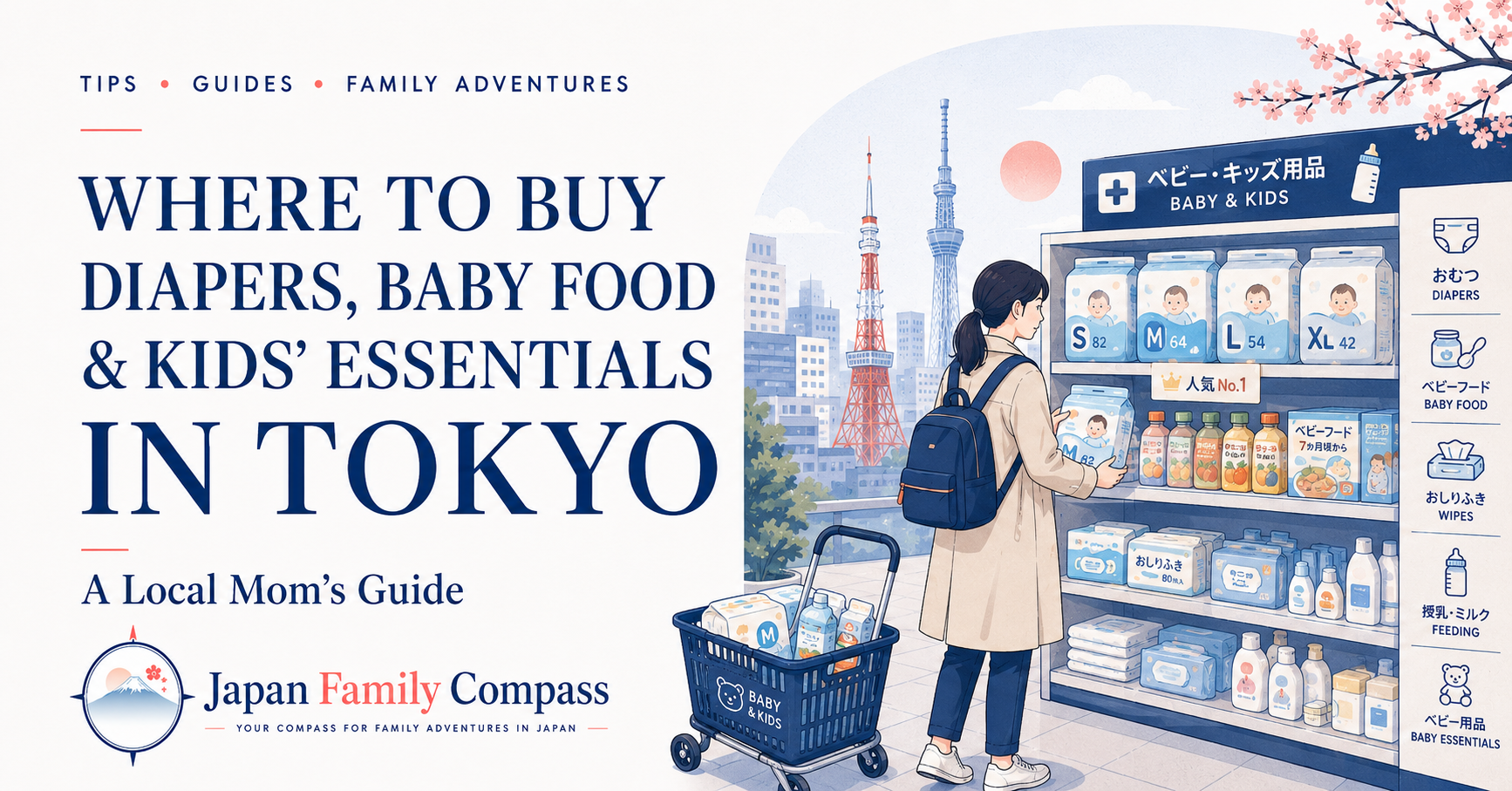
The good news is that buying everyday baby supplies in Tokyo is generally easy — if you know which kind of store to look for.
I’m a Japanese mom living in Tokyo with two young children, and this is where I personally look when we suddenly need baby or kids’ supplies while we are out.
If you’re planning a trip with babies or toddlers, you may also find my guide to Tokyo with Young Kids helpful.
- Quick Answer: Where Should I Go?
- 1. For Diapers, Go to a Drugstore First
- 2. Convenience Stores May Have Diapers — But Never Depend on It
- 3. Japanese Diaper Sizes Are Usually Easy to Understand
- 4. My Personal Guide to the Main Japanese Diaper Brands
- 5. Don’t Expect to Buy Just One or Two Diapers
- 6. Baby Food Is Easier to Find Than Many Visitors Expect
- 7. I Would Not Rely on Convenience Stores for Baby Food
- 8. For Formula, Bottles and Feeding Supplies, Go to a Baby Store
- 9. Important: Akachan Honpo Ikebukuro Tobu Does NOT Sell Diapers
- 10. Nishimatsuya Is My Favorite for Cheap Emergency Clothes
- 11. UNIQLO Is Convenient — But Check the Store First
- 12. MUJI Can Be Great Too — But Again, Store Size Matters
- 13. One Useful Shopping Stop: Gotanda TOC
- 14. My Emergency Shopping Strategy in Tokyo
- 15. You Probably Don’t Need to Pack Every Baby Item for Your Entire Trip
- Final Thoughts
Quick Answer: Where Should I Go?
If you need something right now, this is my basic rule:
Need diapers or wipes?
→ Go to a drugstore.
Need baby food?
→ Try a drugstore or supermarket.
Need formula, feeding supplies or a wider selection of baby products?
→ Try Akachan Honpo or Nishimatsuya.
Need cheap emergency kids’ clothes?
→ Nishimatsuya is my first choice if there is one nearby.
Need several different things at once?
→ A large shopping complex with multiple family stores can save you a lot of time.
And one important point:
Do not assume a convenience store will have baby supplies just because it is open 24 hours.
1. For Diapers, Go to a Drugstore First
If I suddenly run out of diapers while we are out in Tokyo, my first choice is usually a drugstore.
Japanese drugstores sell much more than medicine.
Larger stores often carry:
- Diapers
- Baby wipes
- Baby toiletries
- Sunscreen
- Children’s hygiene products
- Drinks and snacks
- Basic everyday necessities
Chains you may see around Tokyo include Matsumoto Kiyoshi, Cocokara Fine, Welcia and Tomod’s.
You do not necessarily need to find a baby specialty store just for a normal pack of diapers.
2. Convenience Stores May Have Diapers — But Never Depend on It
This is something I would particularly warn international visitors about.
Some convenience stores do sell diapers.
You may occasionally find a small travel-size pack — sometimes just a few diapers.
But it is absolutely not guaranteed.
One convenience store may have them and the next one may have none.
So if you are down to your last diaper, I would not walk from convenience store to convenience store hoping to find some.
Search for a drugstore instead.
Convenience stores are extremely useful for food, drinks, snacks and emergency supplies, but they are not reliable baby stores.
3. Japanese Diaper Sizes Are Usually Easy to Understand
When buying Japanese diapers, look at the weight range in kilograms on the package.
That is usually the easiest way to choose a size close to what your child normally wears.
You will also see different diaper styles, especially:
- Tape-style diapers for younger babies
- Pull-up/pants-style diapers for babies and toddlers
If you are unsure, the baby’s weight is a much better starting point than trying to match Japanese size letters perfectly to a brand you use at home.
That said, different Japanese brands do fit slightly differently.
4. My Personal Guide to the Main Japanese Diaper Brands
These are my personal impressions as a parent, not universal rules — every baby’s body shape and skin are different.
Pampers
I find Pampers particularly thin and compact.
They do not take up much room in a diaper bag, which I like when we are going out.
In my experience, they feel slightly slimmer than some other Japanese brands.
I tend to like them when I want something less bulky or when absorbency is especially important.
Merries
Merries feel very soft and fluffy to me.
They also tend to have a roomier feel compared with slimmer diapers.
I particularly like them for babies with sensitive skin or during warm weather when I am thinking about comfort and breathability.
Moony
What I notice most about Moony is the fit around the waist and legs.
The gathers feel soft and they tend to fit the body gently.
They can work well when you are worried about marks around your baby’s thighs or when you want a secure fit around the legs.
GOO.N
GOO.N tends to feel slightly generous in size to me compared with some competing brands.
It can be useful when your baby is between sizes and you are wondering whether it is already time to size up.
I also think of it as one of the more budget-friendly options.
Again, these are simply my impressions from using Japanese diapers as a parent.
If your usual brand works well for your child and you can find it in Japan, sticking with something familiar may be easiest.
5. Don’t Expect to Buy Just One or Two Diapers
Another thing visitors may not realize is that Japanese drugstores usually sell diapers in normal retail packs.
You generally cannot walk into a drugstore and buy one individual diaper.
Very small packs do exist in some locations, but I would treat those as a lucky find rather than something to depend on.
Hotels, theme parks and some family-oriented facilities may offer individual diapers or very small quantities.
But when you are shopping normally, expect to buy a pack.
6. Baby Food Is Easier to Find Than Many Visitors Expect
If I need baby food while we are out, I normally check:
- Drugstores
- Supermarkets
- Akachan Honpo
- Nishimatsuya
Japanese packaged baby food is widely available in different textures and stages.
Specialty baby stores generally offer the widest selection.
Akachan Honpo, for example, carries baby food across multiple age stages as well as formula, feeding supplies and specialty products, including some organic baby food options.
Drugstores are often the easiest option when you are sightseeing because there are so many of them.
Need infant formula too? See my guide to buying baby formula in Japan, including ready-to-feed options and where to find hot water.
7. I Would Not Rely on Convenience Stores for Baby Food
Convenience stores are wonderful for adults and older children.
For babies, I would keep expectations lower.
I rarely think of a convenience store as somewhere I would deliberately go to buy proper packaged baby meals.
You may find useful things such as:
- Bananas or other fruit
- Yogurt
- Bread
- Plain rice products
- Drinks
depending on the store.
But if you specifically need commercial baby food, I would look for a drugstore or supermarket instead.
8. For Formula, Bottles and Feeding Supplies, Go to a Baby Store
If you need something more specialized than food — for example:
- Infant formula
- Baby bottles
- Bottle nipples
- Feeding spoons
- Baby cups
- Bibs
- Bottle-cleaning supplies
I would look for Akachan Honpo or Nishimatsuya.
Akachan Honpo’s current product range includes formula, bottles, bottle accessories, feeding utensils and baby food across different stages.
These stores are much easier than visiting several small drugstores hoping to find a specific item.
9. Important: Akachan Honpo Ikebukuro Tobu Does NOT Sell Diapers
This is an unusual Tokyo detail worth knowing.
Akachan Honpo Ikebukuro Tobu is extremely conveniently located inside Tobu Department Store, directly connected to Ikebukuro Station.
It is useful for many baby and children’s products.
But despite being an Akachan Honpo, this particular compact branch does not carry disposable diapers.
The store itself confirms this in its official information.
So:
Need baby food or other baby items while you’re in Ikebukuro?
It can be very convenient.
Need diapers urgently?
Go to a drugstore instead.
This is exactly the kind of situation where searching only for “baby store near me” can lead you in the wrong direction.
10. Nishimatsuya Is My Favorite for Cheap Emergency Clothes
If your child spills food everywhere, has an accident, gets soaked in the rain, or simply needs another outfit, Nishimatsuya is one of my favorite options.
It is a Japanese chain specializing in babies and children.
And it is cheap.
Very cheap.
For emergency travel clothes, that can be perfect.
If there is a Nishimatsuya near where you are staying or sightseeing, I would absolutely take a look.
You can buy clothes that you do not have to worry about your child immediately staining again.
For a traveler, that is sometimes exactly what you need.
11. UNIQLO Is Convenient — But Check the Store First
UNIQLO is another obvious option for children’s clothing in Japan.
But there is an important catch:
Not every UNIQLO carries kids’ and baby clothing.
Smaller stores — especially compact locations around stations — may focus on adult clothing.
So do not assume that seeing a UNIQLO sign automatically means you can buy a toddler outfit there.
If you specifically need children’s clothes, check the store’s product categories before making a special trip.
12. MUJI Can Be Great Too — But Again, Store Size Matters
I also like MUJI for children’s basics.
The quality-to-price balance is good, and the designs are simple.
But just like UNIQLO, children’s clothing is not available at every location.
Some larger MUJI stores carry baby and kids’ ranges, while smaller branches may not.
So if you are going specifically for children’s clothes, check the store information first rather than assuming every MUJI has the same selection.
13. One Useful Shopping Stop: Gotanda TOC
If you are staying around Shinagawa, Gotanda, Meguro or southern Tokyo and need several things at once, Gotanda TOC can be surprisingly useful.
It is not a major sightseeing destination.
That is exactly why many overseas visitors probably do not know about it.
Inside the building you can currently find stores including:
- Nishimatsuya
- UNIQLO
- DAISO / Standard Products / THREEPPY
among other shops.
The Nishimatsuya Gotanda TOC store is on the basement floor.
There is also a TOC Express shuttle service connecting the building with Gotanda Station; check the current timetable before traveling.
For a family suddenly needing cheap kids’ clothes, baby supplies and small everyday items, being able to check several stores in the same building can be much easier than traveling across Tokyo to separate shops.
14. My Emergency Shopping Strategy in Tokyo
If I were visiting Tokyo with a baby and suddenly realized I had forgotten something, this is what I would do.
I need diapers right now
Search for:
drugstore
and go to the nearest reasonably large one.
I need baby food
Try:
drugstore → supermarket → baby specialty store
in that order, depending on what is closest.
I need a bottle, formula or specific baby product
Look for:
Akachan Honpo or Nishimatsuya
My child needs an emergency outfit
My preference:
Nishimatsuya → UNIQLO → MUJI
depending on location and store inventory.
I only need fruit or a simple snack
A convenience store may be perfectly adequate.
15. You Probably Don’t Need to Pack Every Baby Item for Your Entire Trip
Parents traveling overseas understandably want to prepare for everything.
But Tokyo has excellent access to everyday shopping.
Unless your child requires a very specific formula, allergy-safe product, medical item or exact brand, you probably do not need to carry every diaper, wipe and snack required for your entire vacation from home.
I would bring enough for:
- The flight
- Arrival day
- A comfortable backup supply
and then buy ordinary supplies locally as needed.
That said, if there is one product your baby absolutely refuses to use an alternative to, bring it.
A vacation is not always the ideal time to discover that your baby strongly disagrees with your emergency replacement.
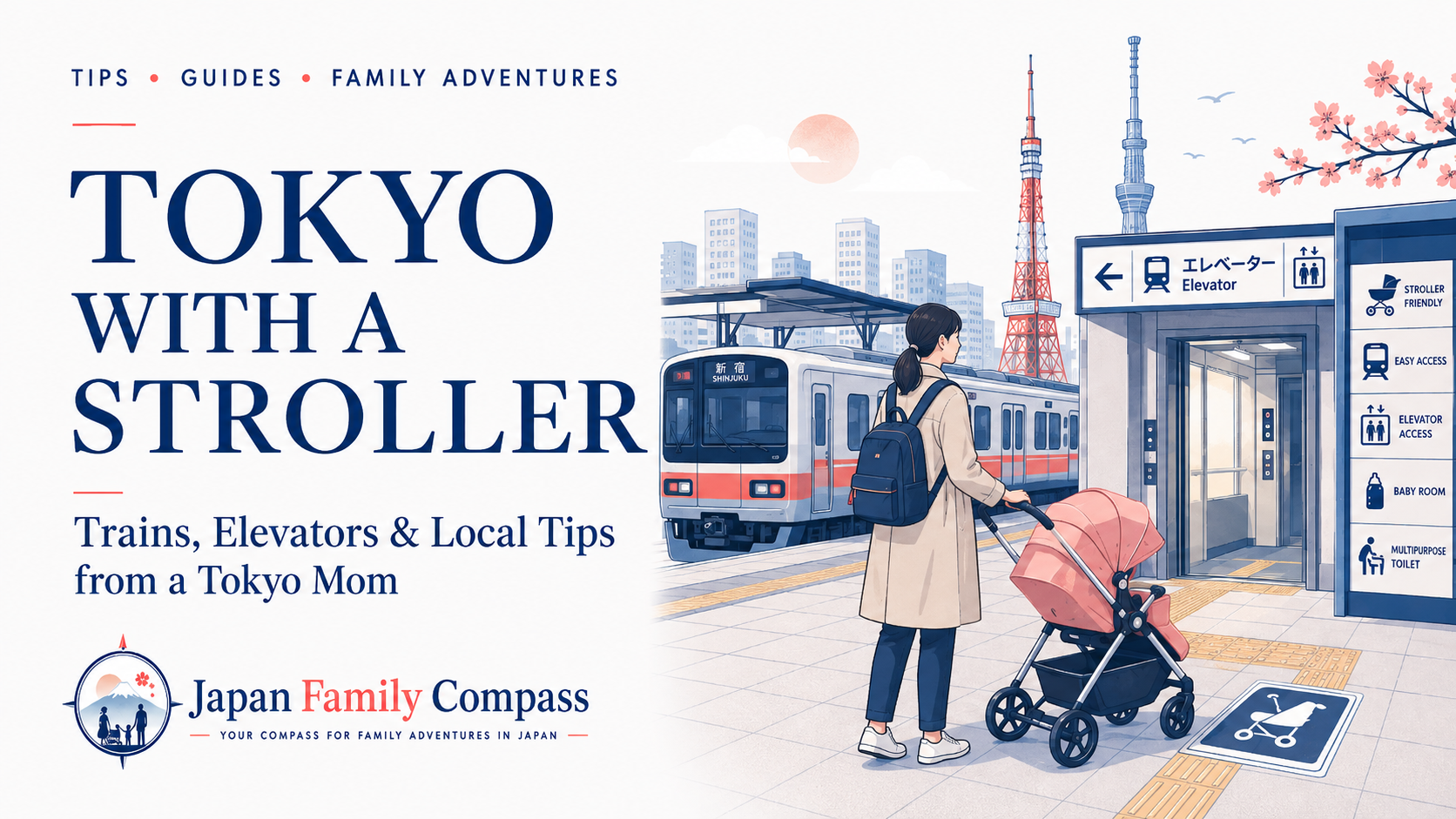
If you’ll be using trains with a stroller, see my practical guide to Tokyo with a Stroller.
Final Thoughts
Finding baby supplies in Tokyo is usually easier than it first appears.
The most important thing is knowing which type of Japanese store to look for.
For diapers and wipes, start with a drugstore.
For baby food, try drugstores and supermarkets.
For specialized feeding equipment or a larger baby selection, look for Akachan Honpo or Nishimatsuya.
For emergency clothes, Nishimatsuya can be a fantastic budget option, while larger UNIQLO and MUJI stores are also useful.
And do not depend too heavily on convenience stores for baby-specific items.
Tokyo may feel enormous when you first arrive, but once you understand how Japanese stores work, replacing the diaper you forgot at the hotel becomes much less stressful.