Affiliate Disclosure: This post contains affiliate links. If you book through these links, I may earn a commission at no additional cost to you.
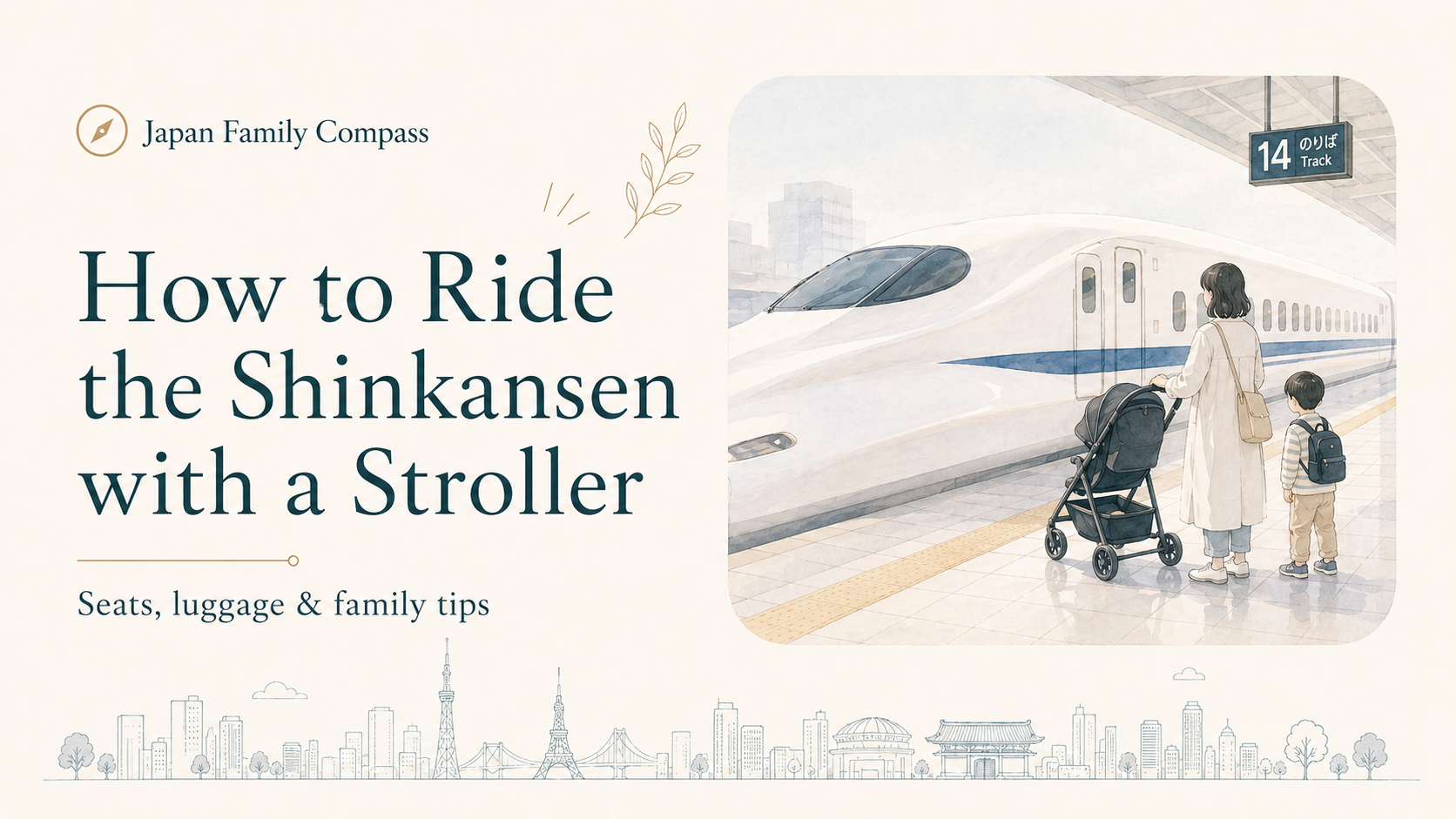
Taking the Shinkansen with a baby, stroller and luggage can feel surprisingly complicated the first time.
Do you have to fold the stroller?
Do you need to reserve an oversized baggage seat?
Which car is easiest with a baby?
How early should you arrive at Tokyo Station?
And what happens when you are carrying a suitcase, diaper bag, stroller and a sleepy child at the same time?
I’m a Japanese mom living in Tokyo with two young children, and I’ve traveled Japan by train with a stroller many times.
Here is what I would want an overseas family to know before taking the Shinkansen with young kids.
If you will also be using Tokyo’s local trains, read my guide to Tokyo with a Stroller.
- Quick Answer: Shinkansen With a Stroller
- 1. A Stroller Does NOT Automatically Require an Oversized Baggage Reservation
- 2. Don’t Assume the Space Behind the Last Row Is Free
- 3. On the Tokaido Shinkansen, I Like Cars 11 and 12 With Kids
- 4. Leaving From Tokyo Station? Plan the Stroller Route Before You Arrive
- 5. Feed and Change the Baby Before Heading to the Platform
- 6. My Timeline for an 8:00 a.m. Shinkansen From Tokyo
- 7. Buy Food and Drinks Before You Board
- 8. One Surprisingly Useful Item: A Small Picnic Sheet
- 9. Simplify the Stroller Before Boarding
- 10. Bring a Baby Carrier as Backup
- 11. What If You’re Taking a JR East Shinkansen?
- 12. Taking the Tohoku, Hokkaido, Joetsu or Hokuriku Shinkansen From Tokyo
- 13. Some Tokaido Shinkansen Stations Have Private “mamaro” Baby Rooms
- 14. Should Your Toddler Have Their Own Shinkansen Seat?
- 15. Japan Rail Pass, SmartEX or Individual Tickets?
- 16. Tokyo to Shin-Osaka? I Sometimes Prefer a Train That Terminates There
- 17. If Two Adults Are Traveling, Divide the Jobs Before Boarding
- My Ideal Shinkansen Setup With Young Kids
- Final Thoughts
Quick Answer: Shinkansen With a Stroller
If you only have 30 seconds, here are the most important things to know.
Do you need an oversized baggage reservation just because you have a stroller?
→ No.
Should you reserve a seat with oversized baggage space if one is available?
→ I usually would, especially with a large stroller and suitcases.
Do you have to fold the stroller?
→ Not automatically. Where you can keep it depends on the train, your seat and available space.
Which area do I personally like on the Tokaido Shinkansen?
→ Around Cars 11 and 12.
Should you buy food before boarding?
→ Yes. Standard Class on the Tokaido Shinkansen no longer has onboard food and drink sales.
How early would I arrive at Tokyo Station with a stroller?
→ Around one hour before departure. During major holiday periods, I would allow even more time.
Now let’s go through the details.
1. A Stroller Does NOT Automatically Require an Oversized Baggage Reservation
This is probably the most misunderstood rule.
On the Tokaido, Sanyo and Kyushu Shinkansen, passengers traveling with certain oversized luggage need to reserve an appropriate seat with baggage space.
But a stroller itself is exempt from the oversized baggage rule.
You do not need to make a special oversized baggage reservation simply because you are bringing a stroller.
However, there is an important difference between:
bringing a stroller onto the train
and
using the designated oversized baggage space behind certain seats.
If you want to use that reserved baggage area for your stroller, you need to reserve a seat that comes with access to that space.
My Local Mom Recommendation
Even though it is not mandatory, if an appropriate seat with baggage space is available, I would seriously consider reserving it.
Especially if you have:
- A stroller
- One or more suitcases
- A diaper bag
- Young children
Knowing exactly where the stroller and luggage will go removes one source of stress before you even board.
With kids, predictable is good.
2. Don’t Assume the Space Behind the Last Row Is Free
You may see empty space behind the last row of seats and think:
“Perfect — I’ll put the stroller there.”
Be careful.
On trains where that area is designated as an oversized baggage space, it belongs to passengers who reserved the appropriate seats.
It is not general first-come, first-served stroller parking.
If you specifically want to store your stroller behind the last row, reserve the corresponding seat when possible.
3. On the Tokaido Shinkansen, I Like Cars 11 and 12 With Kids
When I travel on the Tokaido Shinkansen with children, I personally like the area around Cars 11 and 12.
The multipurpose room is located in Car 11, and I find the restroom and deck area around this part of the train relatively convenient with small children.
In my experience, I also tend to see more families around these cars than in some other parts of the train.
The Multipurpose Room
The multipurpose room can sometimes be used for nursing when it is not already needed by passengers who have priority.
However, you should never assume it will definitely be available.
Passengers with disabilities, passengers who become unwell and others may need it first.
Think of it as a useful backup, not your guaranteed private nursing room.
Family-Friendly Cars During Some Peak Periods
JR Central sometimes designates Car 12 on selected Nozomi services as a special family-friendly car during major travel periods.
These are not available on every train or every day.
But if you are traveling during a Japanese holiday period, it is worth checking whether a family car is being offered.
For parents who worry about their toddler making noise, being surrounded by other families can feel much more relaxing.
4. Leaving From Tokyo Station? Plan the Stroller Route Before You Arrive
Tokyo Station is huge.
Without children, you can simply follow the signs and eventually get where you need to go.
With a stroller, I prefer to know the elevator route before arriving.
For the Tokaido Shinkansen toward Kyoto, Shin-Osaka and beyond, I personally aim for the South Transfer Gate when transferring from JR local trains with a stroller.
The shortest-looking route is not always the elevator route.
That is why I recommend checking the official Tokyo Station map before your travel day rather than relying only on Google Maps.
If You Arrive on the Keiyo Line, Sobu Rapid Line or Tokyo Metro
Allow extra time.
These platforms and stations are deeper underground, and moving all the way to the Shinkansen area with a stroller can take considerably longer than the simple transfer time shown on your phone.
I would personally add about 15 extra minutes.
5. Feed and Change the Baby Before Heading to the Platform
Do not wait until you are standing beside the Shinkansen to suddenly realize the baby needs feeding.
Tokyo Station has baby rooms in the Gransta area, including around the underground Yaesu side.
They can be useful for:
- Nursing
- Diaper changes
- Washing hands
- Giving everyone a few quiet minutes before boarding
My preference is to take care of the baby’s needs before heading to the Shinkansen platform.
Once everyone is fed, changed and comfortable, the rest of the boarding process becomes much easier.
6. My Timeline for an 8:00 a.m. Shinkansen From Tokyo
With a stroller, I would never aim to arrive at Tokyo Station ten minutes before departure.
If our Shinkansen leaves at 8:00 a.m., this is the kind of schedule I would use.
Around 7:00 a.m. — Arrive at Tokyo Station
Yes, a full hour early.
With two adults traveling alone, that may sound excessive.
With young children, I find the buffer reassuring.
If arriving via the Keiyo Line, Sobu Rapid Line or Tokyo Metro, I would arrive even earlier.
7:05–7:20 — Baby, Bathroom and Food
Use the baby room if needed.
Change diapers.
Buy breakfast, drinks and snacks.
Let the children use the restroom.
Do all the things that somehow become emergencies five minutes after a train leaves.
Around 7:20 — Start Moving Toward the Shinkansen
Follow the elevator route toward the Tokaido Shinkansen.
Do not assume the fastest-looking staircase or escalator route will work with your stroller.
Around 7:35–7:40 — Enter the Shinkansen Area
Check your platform and car number.
Around 7:45 — Reach the Platform
Walk to the boarding position for your car before the train arrives.
You do not want to discover that Car 12 is at the other end of the platform while pushing a stroller and carrying three bags.
8:00 — Departure
No running.
No frantic folding of the stroller.
No one shouting, “Where is the diaper bag?”
That is the goal.
Peak-Season Warning
During:
- Golden Week
- Obon
- New Year holidays
- Other major Japanese holiday periods
Tokyo Station can become extremely crowded.
Elevators may have long lines.
During these periods, I would add another 30 minutes to my normal schedule.
This is my personal family-travel buffer rather than an official required arrival time.
7. Buy Food and Drinks Before You Board
This has changed from the Shinkansen experience many people remember.
Standard Class on the Tokaido Shinkansen does not have onboard food and drink sales.
So do not sit down expecting a snack cart to appear later.
Buy what you need before boarding.
With children, I would bring:
- Water
- Snacks
- Breakfast or lunch if needed
- Something the child will reliably eat
- More snacks than seems reasonable
Once a hungry toddler decides they need food immediately, “We’ll buy something when we arrive in Kyoto” is not usually an acceptable answer.
8. One Surprisingly Useful Item: A Small Picnic Sheet
This is a very parent-specific tip.
I sometimes find a small inexpensive picnic sheet surprisingly useful on longer train journeys with children.
You can buy one at a 100-yen shop such as DAISO.
Why?
Children often want to sit differently after an hour or two.
I do not want shoes on the seat.
But I also do not necessarily want a child walking around the train barefoot.
A small clean sheet placed within your own foot space — never blocking the aisle can give you a little more flexibility when your child takes their shoes off.
It weighs almost nothing and takes up very little luggage space.
9. Simplify the Stroller Before Boarding
A stroller may technically fold in five seconds.
Then you attach:
- A diaper bag
- Shopping bags
- Two jackets
- A water bottle
- Toys
- Everything else your family owns
Suddenly folding the stroller becomes a ten-minute operation.
Before reaching the Shinkansen platform, consolidate loose items.
I like having one small bag that stays at our seats with everything we might need during the journey.
For example:
- Diapers
- Wipes
- Drinks
- Snacks
- A change of clothes
- Small toys
- Tissues
The larger luggage and stroller can then stay stored without constant unpacking.
10. Bring a Baby Carrier as Backup
Even if the stroller is your main way of getting around Japan, I recommend a baby carrier for a child who cannot walk long distances.
You may not need it on the Shinkansen itself.
But you may need it:
- At the station
- While storing the stroller
- During a crowded transfer
- When a child falls asleep
- If you suddenly need both hands
I think of the stroller as Plan A and the baby carrier as insurance.
11. What If You’re Taking a JR East Shinkansen?
The luggage setup is different if you are traveling north or toward areas served by JR East.
This includes routes such as:
- Tohoku Shinkansen
- Hokkaido Shinkansen
- Joetsu Shinkansen
- Hokuriku Shinkansen
On these JR East Shinkansen lines, you do not need to reserve luggage storage space.
Storage is generally first come, first served, and strollers can be brought onboard without folding them.
Some trains also have open areas that can accommodate strollers.
So do not assume the Tokaido Shinkansen oversized-baggage reservation system applies to every Shinkansen in Japan.
12. Taking the Tohoku, Hokkaido, Joetsu or Hokuriku Shinkansen From Tokyo
At Tokyo Station, the JR East Shinkansen area has both North and South Transfer Gates.
There are elevator-accessible routes to the Shinkansen platforms.
But if I were traveling with a baby, I would choose the North Transfer Gate when practical.
Why?
Because there is a baby room inside the North Shinkansen Transfer Gate.
It has facilities including:
- Nursing chairs
- Diaper-changing beds
- A sink with hot water
- A diaper bin
That can be extremely convenient before a longer Shinkansen journey.
My Stroller Route
When transferring from a JR local train:
- Take the elevator to the first-floor concourse.
- Follow signs toward the Yaesu / Shinkansen side.
- Head toward the JR East Shinkansen transfer gates.
- If you need the baby room, choose the North Transfer Gate.
- After passing the gate, take the elevator to your Shinkansen platform.
Again, if you are coming from the Keiyo Line, Sobu Rapid Line or Tokyo Metro, allow extra time.
13. Some Tokaido Shinkansen Stations Have Private “mamaro” Baby Rooms
Another useful service international visitors may not know about is mamaro.
JR Central has installed these private baby-care rooms at several Tokaido Shinkansen stations.
They can be used for things such as nursing when you want more privacy.
Current locations include stations such as:
- Shin-Yokohama
- Nagoya
- Kyoto
- Shin-Osaka
and several others along the Tokaido Shinkansen.
Tokyo Station itself is not currently on the mamaro list, so at Tokyo I would use one of the station baby rooms instead.
If you are traveling with a baby, checking the facilities at both your departure and arrival stations can make the day much easier.
14. Should Your Toddler Have Their Own Shinkansen Seat?
JR child fares can be confusing.
In general:
Ages 6–11:
Child fares apply.
Ages 1–5:
They can generally travel free when accompanying an adult and not occupying their own reserved seat.
But if a young child uses their own reserved seat, a child fare and relevant charges are required.
What Would I Do?
For a baby on a shorter trip, sharing a seat may be manageable.
For an older toddler or preschooler traveling:
Tokyo → Kyoto
or
Tokyo → Shin-Osaka
I would seriously consider buying them their own reserved seat if the budget allows.
Two or more hours is a long time to hold a four-year-old on your lap.
15. Japan Rail Pass, SmartEX or Individual Tickets?
International travelers have several ways to book Shinkansen travel.
There is no single best choice for every family.
Already Have a Japan Rail Pass?
Use it.
The Japan Rail Pass can be very convenient if your itinerary includes enough long-distance JR travel to justify it.
You can also make reserved-seat reservations.
However, remember:
NOZOMI and MIZUHO are not included with the standard Japan Rail Pass alone.
To ride those trains, JR Pass holders need to purchase the special NOZOMI MIZUHO Ticket in addition to the pass.
If you are considering a Japan Rail Pass for your trip, compare the total cost of your planned journeys before buying it.
Considering a Japan Rail Pass? Check current Japan Rail Pass options on Klook.
Buying Individual Tokaido Shinkansen Tickets?
SmartEX is an official booking service for the Tokaido, Sanyo and Kyushu Shinkansen.
It allows you to:
- Reserve trains online
- Choose reserved seats
- View a seat map
- Use eligible IC cards or QR tickets for boarding
This is particularly helpful when you want to choose a specific location for your family.
Klook also sells individual Shinkansen tickets on popular routes.
Traveling Tokyo–Kyoto or Tokyo–Osaka? Check current Shinkansen ticket options on Klook.
My Rule
Do not choose a booking method simply because one website looks easiest.
Choose the one that lets you reserve the seat and baggage arrangement your family actually needs.
If having a predictable stroller space is important, confirm that before paying.
16. Tokyo to Shin-Osaka? I Sometimes Prefer a Train That Terminates There
This is purely my personal experience, not an official rule.
If we are only traveling as far as Shin-Osaka and there are several similar options, I sometimes prefer a train that terminates at Shin-Osaka rather than one continuing all the way toward Hakata.
In my experience, it can sometimes feel slightly less hectic.
But this is absolutely not guaranteed.
Departure time, seat availability and your family’s schedule matter much more.
Think of this as one local parent’s small preference — not a secret crowd-avoidance trick.
17. If Two Adults Are Traveling, Divide the Jobs Before Boarding
This sounds overly organized.
It works.
Decide before the train arrives:
Adult 1: child
Adult 2: stroller and large luggage
or whatever division works for your family.
Do not wait until the Shinkansen doors open to start discussing:
“Are you taking the baby?”
“I thought you had the suitcase.”
“Where is the stroller?”
Boarding is much calmer when everyone already knows their job.
My Ideal Shinkansen Setup With Young Kids
If I were planning a longer Shinkansen journey with a stroller, my ideal setup would be:
- Reserved seats
- A predictable place for the stroller and large luggage
- Cars 11–12 on the Tokaido Shinkansen if the available seats work for us
- One small bag at the seat with everything the children need
- Food and drinks bought before boarding
- A baby carrier for a non-walking child
- A small picnic sheet
- At least an hour of buffer time at Tokyo Station
Is that the absolute minimum required to take the Shinkansen?
No.
But family travel is rarely about doing everything with the absolute minimum.
For me, it is about removing as many opportunities for stress as possible.
Final Thoughts
Traveling on the Shinkansen with a stroller is much easier once you understand the system.
The most important point is:
A stroller does not automatically require an oversized baggage reservation.
But if you want to use a designated oversized baggage space — or simply want a more predictable place for a larger stroller and luggage — I recommend reserving the appropriate seat when possible.
Also remember that Shinkansen rules differ depending on the railway company and route.
The Tokaido Shinkansen toward Kyoto and Osaka does not use exactly the same luggage system as JR East’s Shinkansen services toward places such as Sendai, Nagano or Niigata.
Plan the station route.
Reserve seats when possible.
Buy food before boarding.
Give yourself more time than Google Maps suggests.
And once everyone is sitting down with snacks and the stroller safely stored, enjoy the ride.
If you’re planning the rest of your Tokyo trip with a baby or young children, my guide to Tokyo with Young Kids covers more practical tips for trains, strollers, restaurants, baby facilities and easier family travel.
For families, the Shinkansen can actually be one of the easiest — and most enjoyable — ways to travel around Japan.