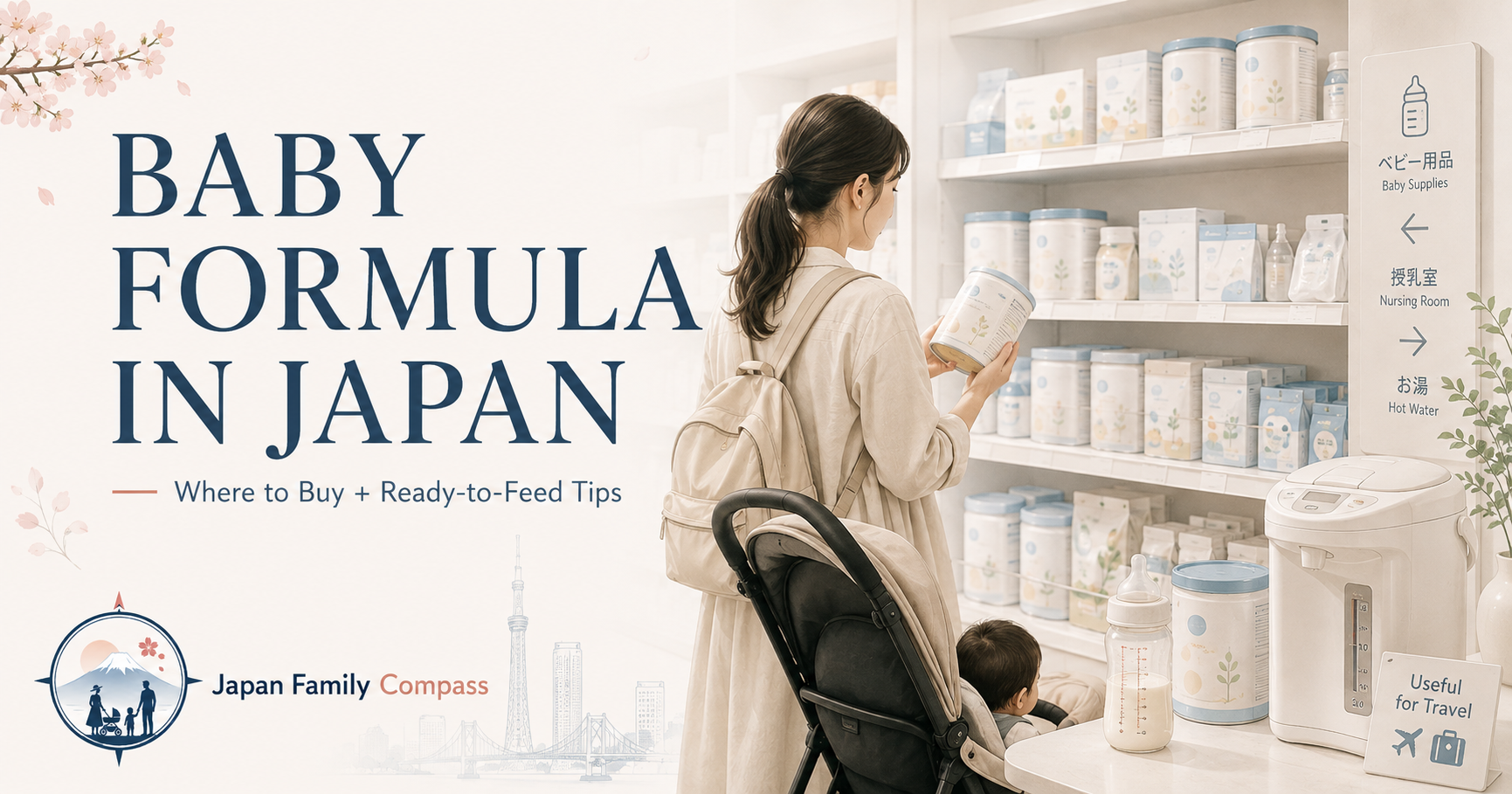
Running low on baby formula during a trip to Japan can feel stressful.
Will a convenience store sell it?
What do the Japanese packages look like?
Can you find ready-to-feed formula?
Where do you get hot water while sightseeing?
And what happens if you suddenly need a bottle too?
I’m a Japanese mom living in Tokyo with two young children, and I have used both powdered and ready-to-feed formula with my own baby.
The good news is that baby formula is not difficult to find in Japan once you know where to look.
If you also need diapers, baby food or children’s essentials, see my separate guide to Where to Buy Diapers, Baby Food & Kids’ Essentials in Tokyo.
- Quick Answer: Where Should I Buy Baby Formula in Japan?
- 1. Akachan Honpo: My First Choice for Baby Formula
- 2. Nishimatsuya Is Another Very Useful Option
- 3. Drugstores Are Usually Fine for Powdered Formula
- 4. Don’t Depend on Convenience Stores
- 5. The Main Types of Baby Formula You’ll See in Japan
- 6. My Experience: Ready-to-Feed Formula Is Convenient — If Your Baby Will Drink It
- 7. Common Baby Formula Brands in Japan
- 8. Be Careful: “Follow-Up Milk” Is Not the Same as Infant Formula
- 9. Where Can You Get Hot Water While Sightseeing?
- 10. How Hot Should the Water Be for Powdered Formula?
- 11. What Bottled Water Can You Use in Japan?
- 12. What If You Forgot the Bottle?
- 13. Formula Tips for Hotels in Japan
- 14. If Your Baby Uses a Special Formula, Bring It With You
- My Emergency Baby Formula Shopping Plan
- What I Would Pack for a Formula-Fed Baby in Japan
- Final Thoughts
Quick Answer: Where Should I Buy Baby Formula in Japan?
If you need formula right now, this is the order I would try.
Best choice for the widest selection:
→ Akachan Honpo or Nishimatsuya
Usually good for powdered formula:
→ Drugstores
Sometimes useful:
→ Larger supermarkets
Would I rely on a convenience store?
→ No. In my experience, convenience stores generally do not carry baby formula consistently.
Need ready-to-feed liquid formula?
→ Go to a baby specialty store if possible. I see powdered formula much more often in ordinary drugstores than liquid formula.
Need a bottle too?
→ Akachan Honpo and Nishimatsuya sell bottles, nipples and other feeding supplies. You can even find disposable bottles in Japan.
If I were an overseas parent who suddenly realized, “We only have enough formula for tonight,” I would search Google Maps for:
Akachan Honpo
or
Nishimatsuya
first.
1. Akachan Honpo: My First Choice for Baby Formula
If you have an Akachan Honpo nearby, this would usually be my first stop.
Akachan Honpo is a large Japanese baby and maternity chain, and its current formula section separates products into infant formula, follow-up formula and specialty formula. Its product listings include powdered formula, sticks, cubes and ready-to-feed liquid products from multiple manufacturers.
As a parent, what I like is that you can solve several problems at once.
You can usually look for:
- Baby formula
- Baby water
- Bottles
- Nipples
- Bottle-cleaning supplies
- Disposable bottles
- Baby food
- Diapers
That is much easier than visiting three different stores during a sightseeing day.
Local mom tip: If you need more than just a can of formula, I would choose Akachan Honpo over a random drugstore.
2. Nishimatsuya Is Another Very Useful Option
Nishimatsuya is another major baby and children’s chain.
It sells a wide range of infant formula, including products from brands such as Meiji, Wakodo, Morinaga and Snow Beanstalk, as well as feeding supplies. Its current online formula category includes products for babies from birth as well as formula intended for older children.
I often buy baby products from either Akachan Honpo or Nishimatsuya because the selection is much broader than at a small pharmacy.
These stores are especially useful if you also need a bottle or other feeding equipment.
3. Drugstores Are Usually Fine for Powdered Formula
If there is no baby store nearby, try a Japanese drugstore.
In my experience, most reasonably sized drugstores carry at least some powdered infant formula.
You may see chains such as:
Matsumoto Kiyoshi
Welcia
Tomod’s
Sundrug
Cocokara Fine
The exact brands and sizes vary by location.
I would not expect every small drugstore to carry every brand.
And I would especially not rely on a drugstore for ready-to-feed liquid formula. I see powdered formula much more often.
But in an emergency, a drugstore is usually the first ordinary shop I would check.
4. Don’t Depend on Convenience Stores
Japan’s convenience stores are wonderful for many travel emergencies.
Baby formula is not one of the things I would count on.
In my experience, convenience stores generally do not reliably stock infant formula.
You might occasionally find baby-related items at a large or unusual location, but I would never plan a trip assuming FamilyMart, Lawson or 7-Eleven will have the formula your baby needs.
For formula:
baby store → drugstore → supermarket
is the order I would use.
5. The Main Types of Baby Formula You’ll See in Japan
Japan has more travel-friendly formula formats than some visitors expect.
Powdered Formula
This is the easiest type to find.
It may come in:
- Large cans
- Small cans
- Refill-style packs
- Individual sticks
For example, Snow Beanstalk’s current Sukoyaka M1 range includes large and small cans, regular sticks and smaller individually portioned sticks.
Powder is usually the easiest option if you need to buy enough formula for several days.
Stick Packs
Stick packs are useful for travel because the powder is already portioned.
You do not have to carry an entire can around Tokyo.
Several brands offer them, including Sukoyaka M1, Morinaga Hagukumi and Wakodo Haihai.
Formula Cubes
This is one Japanese product format that overseas parents may find particularly interesting.
Meiji Hohoemi Rakuraku Cube comes as pre-portioned solid cubes rather than loose powder.
Meiji currently sells multiple box sizes, including small packs, and describes the cube format as an easier way to measure formula accurately.
For travel, I can see why parents like this.
There is less measuring, and the individual packs are easy to put in a diaper bag.
Ready-to-Feed Liquid Formula
Japan also has ready-to-feed infant formula.
You do not add water to it.
Examples currently include:
Snow Beanstalk Sukoyaka M1 liquid formula — 200 ml cans.
Meiji Hohoemi Rakuraku Milk — ready-to-feed liquid formula.
ICREO Akachan Milk — currently sold in 125 ml paper cartons and designed to be fed without dilution.
Ready-to-feed formula can be extremely convenient when you do not have access to hot water.
But there is one big practical warning.
6. My Experience: Ready-to-Feed Formula Is Convenient — If Your Baby Will Drink It
With my own child, I used Sukoyaka M1, both powdered formula and ready-to-feed liquid formula.
The liquid version was incredibly convenient.
No measuring.
No hot water.
No waiting for the bottle to cool.
That is especially attractive when you are outside all day or dealing with a travel disruption.
But my baby personally did not like the liquid version very much.
That taught me something I think is important for traveling parents:
Do not make an unfamiliar ready-to-feed formula your only backup without knowing whether your baby will actually drink it.
Even if two products are both nutritionally appropriate infant formulas, babies can have preferences about taste, temperature or familiarity.
If you plan to rely heavily on ready-to-feed formula during your Japan trip, I would test the product your baby normally uses — or an equivalent travel format — before you really need it.
7. Common Baby Formula Brands in Japan
You do not need to memorize every Japanese brand.
But these are some names you may see.
| Brand | Products you may see | Traveler-friendly formats |
|---|---|---|
| BeanStalk Sukoyaka M1 | Infant formula from birth | Powder, sticks, mini sticks, ready-to-feed liquid |
| Meiji Hohoemi | Infant formula from birth | Powder, cubes, ready-to-feed liquid |
| Morinaga Hagukumi | Infant formula from birth | Powder, refill packs, sticks and liquid products |
| ICREO Balance Milk | Infant formula from birth | Powder, sticks; ICREO also sells ready-to-feed Akachan Milk |
| Wakodo Haihai | Infant formula from birth | Powder and sticks |
Current manufacturer and retailer listings confirm these product lines, although individual store inventory varies.
I would not choose between these brands based on an internet ranking while standing in a Japanese drugstore.
If your baby already uses a specific formula, ingredient profile or specialty product, that is a different situation.
8. Be Careful: “Follow-Up Milk” Is Not the Same as Infant Formula
This is one packaging mistake I would really want overseas parents to avoid.
Japanese baby stores often place infant formula and follow-up formula near each other.
Look for the age range.
For example:
Meiji Hohoemi is an infant formula line.
But Meiji Step is designed for children around ages 1–3.
Similarly:
Wakodo Haihai is infant formula from birth to around the first birthday.
Wakodo Gungun is follow-up formula intended from around 9 months to approximately 3 years.
Useful Japanese words:
乳児用調製粉乳
Infant powdered formula
乳児用調製液状乳
Ready-to-feed infant liquid formula
フォローアップミルク
Follow-up milk/formula
0か月
0 months
1歳
1 year old
Do not choose a can simply because there is a baby on the packaging.
Check the age range.
9. Where Can You Get Hot Water While Sightseeing?
This is one thing that is easier in Japan than many parents expect.
I often use baby rooms when I need to prepare formula outside the house.
Larger baby rooms in shopping centers, department stores and family facilities often have hot water specifically for formula preparation.
Look for signs such as:
ベビー休憩室 — Baby room / baby rest area
授乳室 — Nursing room
調乳用温水 — Hot water for preparing formula
Not every baby room has the same facilities, so I would still check before you depend on one.
What About Restaurants?
If you are eating at a restaurant, you can also ask whether they can provide hot water for baby formula.
In my experience, restaurants will sometimes help if you explain that it is for the baby’s milk.
But I treat this as a kind favor, not a guaranteed service.
I would not arrive with an empty thermos and assume every café can solve the problem.
10. How Hot Should the Water Be for Powdered Formula?
This is where I would follow safety guidance rather than travel-blog shortcuts.
Japan’s Ministry of Health states that water used to prepare powdered infant formula should be kept at 70°C or above, because powdered formula itself is not sterile.
Formula that has not been used within two hours after preparation should be discarded.
So even if you see parents using bottled water or a baby-room dispenser, always follow:
the instructions on your formula package
plus
safe preparation practices.
Do not simply mix powder with room-temperature bottled water.
11. What Bottled Water Can You Use in Japan?
Japan has many soft bottled waters.
One easy-to-find option I personally use is plain I LOHAS.
Japan Coca-Cola states that unflavored I LOHAS is soft water with hardness below 100 mg/L and is suitable for preparing baby formula. It also says to follow the formula manufacturer’s instructions when mixing powdered formula.
Important:
I mean plain water.
Not peach I LOHAS.
Not grape.
Not lemon.
Japan sells many flavored versions under the same brand name, so check the bottle.
You can find plain bottled water at:
- Convenience stores
- Vending machines
- Supermarkets
- Drugstores
Akachan Honpo and Nishimatsuya also commonly sell water specifically marketed for baby feeding.
For powdered formula, the bottled water does not replace the ≥70°C preparation requirement. Think of it as a suitable water source to have available while following the formula’s preparation instructions.
12. What If You Forgot the Bottle?
This is another reason I like baby specialty stores.
You can buy an ordinary baby bottle in Japan.
But you can also find single-use disposable feeding bottles.
One example is chu-bo!, a sterilized, disposable bottle designed for travel and emergencies.
The manufacturer currently lists Akachan Honpo, Nishimatsuya and Aeon among its retailers. The bottles come sterilized and do not require washing before first use.
Akachan Honpo also currently carries chu-bo! and other disposable bottle options.
This could be useful if:
- Your bottle is lost
- You forgot one at the hotel
- You do not have an easy way to wash and sterilize bottles
- You want an emergency backup in your day bag
I would not necessarily switch an exclusively breastfed baby to an unfamiliar bottle without expecting some resistance.
But knowing this exists can be reassuring.
13. Formula Tips for Hotels in Japan
If your baby drinks powdered formula, I would check your hotel setup on the first night, not at 2 a.m. when the baby wakes up.
Check:
- Is there an electric kettle?
- Where can you wash the bottle?
- Do you have clean space to dry feeding equipment?
- Is there a refrigerator if you need one for other baby food?
- Where is the nearest baby store or drugstore?
- Do you have enough formula for the next morning?
I would also keep one feeding’s worth of supplies separate from the main luggage.
Hotel rooms in Japan can be small.
You do not want to unpack an entire suitcase in the dark just to find one formula stick.
14. If Your Baby Uses a Special Formula, Bring It With You
This article is mainly about ordinary infant formula for healthy babies.
If your child needs:
- Allergy formula
- Extensively hydrolyzed formula
- Amino-acid formula
- Formula for a medical condition
- Premature-infant formula
- Another specific product recommended by a doctor
I would not assume you can buy an equivalent easily after arriving in Japan.
Japan does sell specialty formula products, but some are intended for use under medical guidance and availability is very different from ordinary supermarket formula.
For a medically necessary formula, bring enough for the trip plus a sensible buffer and discuss substitutions with your child’s healthcare professional before travel.
My Emergency Baby Formula Shopping Plan
If I suddenly ran out of formula while traveling in Japan, I would do this:
1. Search Google Maps for Akachan Honpo or Nishimatsuya.
If one is reasonably close, go there.
2. If not, search for a large drugstore.
Powdered formula is much easier to find than liquid formula.
3. Check the age range carefully.
Make sure you are buying infant formula rather than follow-up milk.
4. Buy enough for more than one feed.
Do not repeat the emergency six hours later.
5. If you also need a bottle, buy it at the same time.
Ask about disposable options if washing or sterilizing will be difficult.
6. Before leaving the store, work out your next feeding.
Where will you get ≥70°C water?
Or are you buying ready-to-feed formula?
This is the kind of five-minute planning that can save a lot of stress later.
What I Would Pack for a Formula-Fed Baby in Japan
For a day out, my basic setup would be:
- Enough formula for the planned feeds
- One extra feed
- Bottles
- A small thermos if needed
- Plain baby-safe water
- Bib or cloth
- Plastic bag for used items
- Ready-to-feed formula as backup, if my baby already drinks it
- A disposable bottle as an emergency option
You do not need to carry your entire kitchen around Tokyo.
But with babies, one backup feed is rarely wasted peace of mind.
Final Thoughts
If you run out of baby formula in Japan, you probably do not need to panic.
Powdered infant formula is widely sold at baby specialty stores and commonly available at drugstores.
For the widest selection — especially if you also need bottles, baby water or ready-to-feed formula — I would look for Akachan Honpo or Nishimatsuya first.
My biggest parent tips are:
Do not rely on convenience stores.
Check the age range so you do not accidentally buy follow-up formula.
Do not assume every store will carry ready-to-feed formula.
Know where you will get safe hot water before the baby is already hungry.
And if you want to rely on ready-to-feed formula during your trip, make sure your baby actually likes it first.
If you’re planning a trip to Japan with a baby, you may also find my guides to Where to Buy Diapers, Baby Food & Kids’ Essentials in Tokyo and Tokyo with Young Kids useful.